

If you’ve ever tried to meditate and ended up doom-scrolling instead, this new piece of wearable tech is going to sound very strange—and strangely useful.
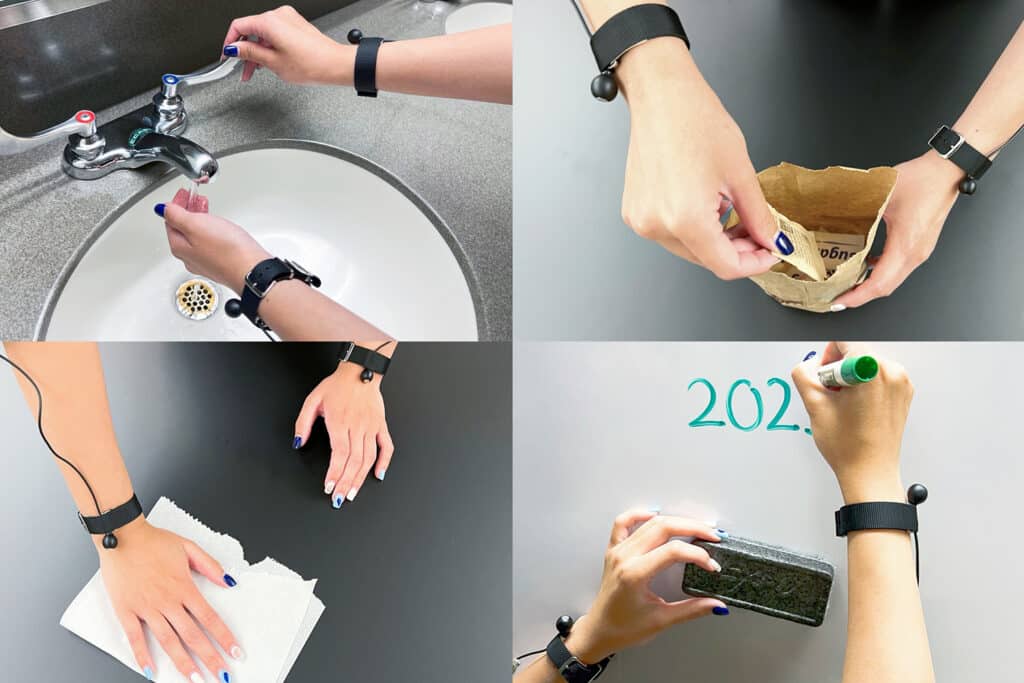
Stanford researchers have built a mindfulness wearable that doesn’t track your heart rate or steps. Instead, it listens to the tiny sounds your hands make while you move through your day and turns them into a kind of live mindfulness soundtrack.
Think: the whisper of your palms rubbing together, the scratch of a marker on a whiteboard, the swish of fabric as you wipe down a table, the whoosh of water from a faucet. The device amplifies those sounds in real time through your earbuds, nudging your attention back to what your body is actually doing—rather than whatever’s on your screen.
“We wanted to create something that makes us more aware of our surroundings and to appreciate the real world over the digital,” says Sean Follmer, senior author of the study and director of Stanford’s SHAPE Lab.
How the Device Works
The hardware is surprisingly simple:
- Two wrist straps with tiny microphones capture sounds produced by your hands as you touch and manipulate objects.
- A small processor amplifies and cleans up those sounds.
- The audio is streamed straight to your earbuds in real time.
Unlike most mindfulness apps, there’s no voice telling you what to do, no guided body scan, no breathing script. Instead, the device uses sensory feedback—your own amplified hand sounds—to pull your attention into whatever you’re doing right now.
Lead author Yujie Tao calls it a way to transform normally “mundane” tasks—like washing your hands or making coffee—into moments of curiosity and focus.
What They Found in the Lab
To see if this actually worked, the team ran a controlled experiment with 60 participants in a lab setting. Each person performed everyday tasks with different objects—writing, cleaning, handling materials—either with audio augmentation or without it.
The results:
- People using the device reported significantly higher levels of mindfulness, measured with a standard questionnaire (the Mindful Attention Awareness Scale – State).
- They spent more time exploring objects and showed more trial-and-error behavior, suggesting deeper engagement with the task.
In earlier formative studies with mindfulness coaches, participants described the experience as:
- “Like being a child again”
- “Intimate” and “safe”
- “A way of helping people fall in love with the world again”
In other words, amplifying the tiny sounds of everyday life didn’t just feel like a gimmick—it changed how people related to the moment in front of them.
Why This Matters for Recovery & Mental Health
Most of us now carry a high-powered distraction machine in our pocket all day. The Stanford team explicitly frames this device as an antidote to that:
There’s “so much time that we spend… making coffee or waiting in line… endlessly scrolling on our phones. Meanwhile, life is passing us by,” Follmer notes.
By turning hand movements into a subtle audio landscape, the device:
- Encourages micro-moments of mindfulness throughout the day
- Helps users stay with a simple task instead of mentally checking out
- Could, over time, support recovery from stress, digital overload and attention fatigue
The researchers are now exploring what this might mean for clinical settings, especially for people living with anxiety disorders or ADHD who struggle to stay grounded.
Imagine pairing this with:
- A recovery lounge in a gym or corporate wellness space
- Short “mindful work breaks” between deep-focus sessions
- At-home routines for people working on stress or attention challenges
It’s not a product you can buy yet, but it’s a strong signal of where recovery tech might be heading: less about dashboards and more about bringing you back into your body in real time.
