

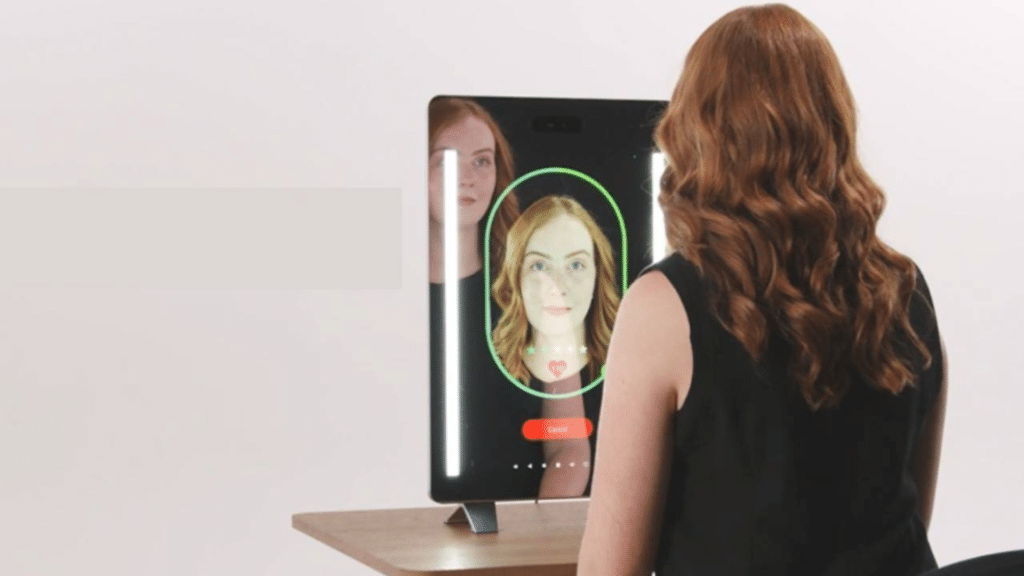
The idea (in one sentence)
A full-size mirror takes a ~30-second facial video, analyzes subtle facial blood-flow patterns, and turns it into a set of “future health” indicators—meant to reflect your trajectory, not diagnose you.
What it’s actually doing
Under the hood is NuraLogix’s “Transdermal Optical Imaging,” which looks at tiny blood-flow changes in the face that your eyes can’t see. Those signals feed computer vision + AI models that generate a 0–100 Longevity Index and related indicators (cardio/metabolic signals, stress/recovery, “physiological age,” etc.).
They also claim models trained on large datasets can estimate multi-year health risk trends—framed as looking as far as years/decades ahead.
The most useful way to use a tool like this
Think of it like a habit mirror, not a prophecy.
- Use it for trends, not one-time truth. One reading can be noisy. Repeating monthly (same time, similar conditions) is where patterns show up.
- Convert the score into one lever. If your “stress/recovery” looks off, the action isn’t “optimize everything.” It’s “lights out 30 minutes earlier 4 nights/week” or “walk 10 minutes after lunch.”
- If it flags something scary, confirm it elsewhere. Risk estimates aren’t diagnoses. If you’re worried, a real clinician + standard testing is the move.
Promising-but-early note
This is still a new category. Risk scoring from facial blood-flow signals is intriguing, but it’s not the same as medical-grade screening—and “future health” claims should be treated as directional until independently validated at scale.
